Houston / Master Framework
The Master Framework in Houston: four channels installed as one system, not four invoices
Ask around the Houston trade groups and the same story comes up: the map-pack agency says the site is the problem, the ads shop says the leads were bad, and the Instagram guy sends a reach screenshot instead of a job count. Three invoices, three excuses, and nobody willing to say what a lead actually cost in Bellaire versus Baytown. That is why a seven-million-person market needs one team holding all four levers against one shared scoreboard, not four contractors defending their own slice.
The short answer
The Master Framework is Extentus installing all four channels — SEO, Google advertising, social advertising and web design — as one system for a Houston business, with one strategy, one accountable record of qualified inbound by channel and by suburb, and budget shifted between channels as demand windows open and close across Harris, Fort Bend and Montgomery counties.
01. The argument
In a metro this size, four separate invoices just buy four people guessing.
Houston is the largest and most competitive home services market in Texas, and it is also the easiest place to spend marketing money badly. The reason is structural, not lazy: a single-channel vendor is paid to defend its channel. The SEO vendor cannot recommend pulling budget into paid search during a rain event, because that money leaves their invoice. The paid search vendor has no incentive to flag a broken site, since fixing it belongs to somebody else's contract. The social vendor hands you a reach number because reach is the one metric inside their own walls. Every one of them is behaving rationally, and the result is a business that pays full Houston rates for a system that does not exist.
Bundled into one system, the four channels start subsidizing each other's cost. SEO lowers the share of calls you have to rent from an auction bid up by roll-ups and franchises. The site raises what every expensive click is worth. Social fills the mild weeks when emergency volume dips. Paid search covers the hours when a heat wave, a freeze or ten inches of rain triples demand and rankings cannot move. That kind of trade-off is impossible when four separate companies each guard one lever and one invoice.
02. Why Houston in particular
Scale, no center, and demand that arrives in bursts.
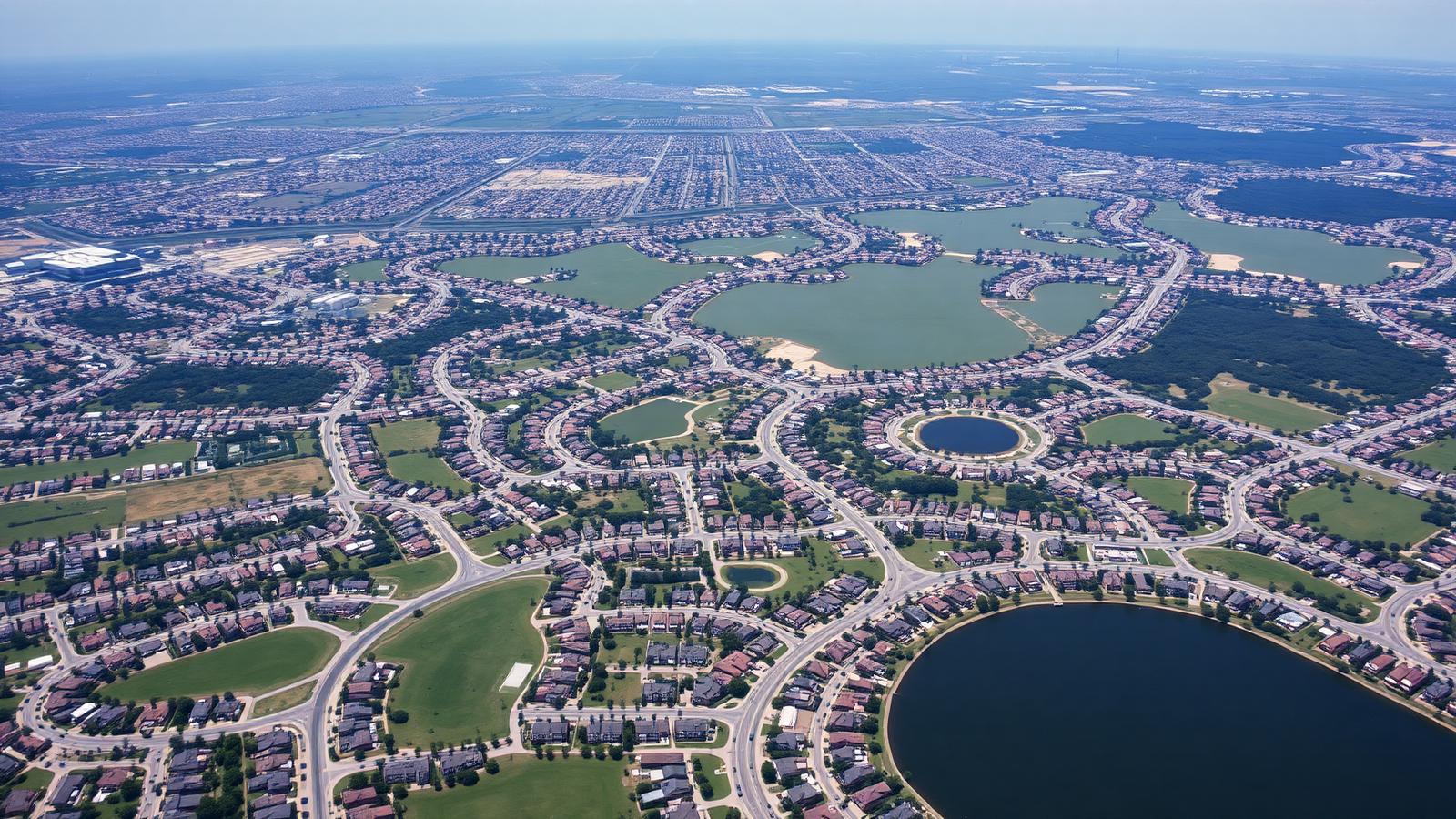
The metro exceeds 7.3 million people across nine counties and more than 10,000 square miles — larger than New Jersey — with roughly 4.8 million in Harris County and continued rapid growth in Fort Bend and Montgomery counties. There is no single downtown that organizes demand and no zoning to concentrate it; the market reads as ring-road bands, from inside the Loop out past Beltway 8 and the Grand Parkway. Any strategy that treats that as one market fails in the same predictable way: visible near the shop, invisible everywhere else, and paying for traffic thirty miles past a profitable drive time.
The climate then decides the calendar. Gulf humidity keeps cooling systems under near-continuous load from May into October, so HVAC failures cluster in sustained hot stretches rather than on one peak afternoon. Flat terrain drained by bayous rather than by slope means Houston's flood risk is a rainfall-and-drainage mechanism, not coastal surge — intense storms overwhelm the channel system and put water into neighborhoods far inland, producing seventy-two-hour waves of drying, flooring, coating and equipment work in specific watersheds. Rare freezes hit plumbing across the entire metro at once. Between events, gumbo clay moves with every wet-dry cycle and cracks concrete continuously, and roughly 2.4 million housing units — a large share built between 1950 and 1990 — keep aging into replacement work street by street.
That mix is exactly why four channels are needed and why the mix has to move. A market with sharp bursts needs a channel that can surge. A market this large needs a durable page layer to be visible past a ten-mile radius. A market full of long-deferred elective projects needs demand created, not captured. And a market where every visitor is hiring a stranger on a phone needs a site that converts and can be cited.
03. How the four interlock
Nine counties, four jobs, one shared scoreboard.
SEO carries the weight that never has to be re-earned: a Google Business Profile built out with real Houston job photos, a steady drip of new reviews rather than a single forty-review push, and dedicated pages for the Heights, Bellaire, Memorial, Meyerland, Clear Lake, Katy, Cypress, Sugar Land, Missouri City, Pearland, Friendswood, League City, Spring, Tomball, The Woodlands, Kingwood, Humble and Baytown. It is how a company with one shop location shows up as local across nine counties without opening a second office — and it cannot spike for a flood on 48 hours' notice.
Google advertising owns the hour. Search and Local Services Ads bid by band and by hour, with negatives that strip DIY, parts and rental traffic, and pre-built storm, heat and freeze campaigns with budget headroom held in reserve. It surges and it does not compound.
Social advertising owns the backlog. Epoxy garage floors, covered patios and pergolas, outdoor kitchens, pool decks, fence replacement, turf and remodels, sold on video shot at your own Houston job sites and aimed at the subdivisions whose housing matches the service. It creates demand the other two can only wait for, and it fills the seams between bursts.
Web design owns the conversion and the citation. Fast on cellular, click-to-call in a fixed header, separate emergency and planned-project paths, suburb and service pages that match the searches, and LocalBusiness, Service and FAQ schema so answer engines can name the business. On its own it books zero leads; its job is multiplying whatever the other three already produce.
A single monthly ledger connects all four: qualified inbound sorted by channel and suburb, cost per qualified inbound, and which page or campaign earned it. That single number set is what makes the trade-offs arguable instead of political — you can see that Katy organic is carrying itself while Pearland still needs paid support, rather than reading a metro-wide average that hides both.
04. The math on the bundle
Bought together, Houston's channels subsidize each other.
Run separately in Houston, each channel pays full rate. Bought leads and emergency clicks are priced by the best-funded bidder in the fourth-largest city in America. A site that converts at three percent makes every one of those clicks worth half of what it should be. Social spend aimed at a site that doesn't convert just generates curiosity that fades by morning. SEO run alone goes quiet in exactly the seventy-two hours when a watershed floods and a year's worth of flooring work is being assigned.
Run together, the arithmetic changes. Organic share reduces the volume of rented calls. A better-converting site instantly raises what every paid click and every organic visit is worth. Social lowers blended cost per job by producing high-ticket elective work at impression prices instead of emergency click prices. And the freedom to move budget across the year — paid up during the August humidity and the January freeze scare, social up in the mild stretches, always funding the page layer — is worth more than any single-channel optimisation, because it is the only thing that matches spend to when Houston demand actually appears.
05. What Extentus runs
What gets built first, second, and every month after.
The build starts with the website, since it multiplies everything else and every other channel dumps its traffic there. Next comes the Google Business Profile and the suburb-by-suburb page structure for the Harris, Fort Bend and Montgomery communities you actually service. We stand up paid search on the bands where your drive times and ticket sizes work, with storm, heat and freeze playbooks ready before the window opens. Social creative gets filmed at your actual job sites and aimed at the subdivisions whose housing stock fits the service. From there, one monthly number set gets reported and budget shifts to wherever the data says it should go.
For the discipline-by-discipline detail — SEO, Google advertising, social advertising and web design — read the four dedicated Houston pages, then set up a call. It runs as a single engagement because splitting it apart is exactly what breaks it.

Where we run master framework in Houston
The Master Framework for service businesses across Houston and Harris County, plus the satellite towns crews already drive to. Every district below is targeted by name in campaigns, pages and profile service areas — not folded into a single city radius.
- Houston districts
- Downtown Houston · The Heights · Montrose · Midtown · Museum District · Rice Military · River Oaks · Memorial · Spring Branch · Bellaire · West University Place · Meyerland · Sharpstown · Energy Corridor · Clear Lake · Kingwood · Champions · Alief
- Beyond the county line
- Katy · Cypress · Sugar Land · Missouri City · Richmond · Pearland · Friendswood · League City · Spring · Klein · Tomball · The Woodlands · Humble · Atascocita · Baytown · Conroe · Harris County · Fort Bend County · Montgomery County · Galveston County · Brazoria County
- ZIP codes covered
- 77002 · 77004 · 77005 · 77006 · 77007 · 77008 · 77009 · 77018 · 77019 · 77024 · 77025 · 77027 · 77030 · 77035 · 77040 · 77043 · 77055 · 77056 · 77057 · 77063 · 77065 · 77070 · 77077 · 77079 · 77080 · 77084 · 77095 · 77096 · 77098 · 77339 · 77379 · 77401 · 77429 · 77433 · 77450 · 77478 · 77494 · 77502 · 77546 · 77573 · 77584

06. The Houston close
The biggest market in Texas rewards system, not vendors.
More than 7.3 million people, roughly 2.4 million housing units, nine counties, 10,000-plus square miles, no single center, and a climate that generates continuous cooling load, continuous clay movement and periodic bayou-driven flooding. That is a market with more work in it than any other in Texas and more competition for that work than anywhere else in the state.
Nobody wins it by buying one channel well. It is won by covering the suburbs you can profitably serve, being able to surge when a window opens, creating demand in the seams, converting every visitor a phone hands you, and keeping one honest record of which of those produced booked jobs. That is the Master Framework, and in Houston it is the difference between paying for marketing and owning a growth system.
Master Framework in Houston — questions, answered
Because in Houston each channel has a hole the others fill, and the holes are expensive. SEO compounds but cannot surge on the morning after a bayou floods or during a January freeze scare. Paid search surges but rents every call in the most expensive auction in Texas. Social creates elective demand but converts nothing on its own. The site multiplies all of them and generates none. Bought separately you pay full rate for four partial systems and no vendor is accountable for booked jobs; installed together the channels lower each other's cost and one number set shows what worked.
It starts weighted toward the site and the page layer, because those are the multiplier and the durable asset, then moves with the calendar. During sustained humid stretches, freeze warnings and rain events, paid search and Local Services Ads take priority because demand triples for seventy-two hours and rankings cannot move. In milder weeks, social takes more share to create elective patio, epoxy, fencing and remodel work while crews have capacity. SEO funding stays constant throughout because interrupting it loses compounding. Every shift is argued against reported cost per booked job by suburb.
By suburb, not by average, because a metro-wide number hides both the wins and the failures. Every month you get one record: qualified inbound by channel and by suburb, cost per qualified inbound, the pages and campaigns responsible, and booked jobs where the data supports it. That structure makes the honest calls possible — for example that Cypress and Katy organic are self-sustaining while Pearland still needs paid support — and it is why a single accountable team, rather than four vendors defending four invoices, is the point of the framework.
The four Houston pages, individually
Each discipline's own Houston page — its own local search data, its own market detail, its own URL.
- SEO
Search Engine Optimization in Houston
The channel you own. Google Business Profile, Harris County and suburban service-area pages and review velocity, built so Houston searches for your trade land on you instead of a national franchise buying its way into a market it does not work in.
Open page - Google Ads
Google Advertising in Houston
The channel you can turn up tonight. Search and Local Services Ads bid by suburb and by hour across Harris, Fort Bend and Montgomery counties, with negatives that strip DIY and parts traffic before it reaches your budget.
Open page - Social Ads
Social Advertising in Houston
The one channel built to manufacture demand rather than sit around waiting for it to show up in search. Meta, Instagram and short-form video aimed at the Houston suburbs where the housing matches the service, at a fraction of what an emergency search click costs here.
Open page - Web Design
Web Design in Houston
The conversion layer and the citation surface. Fast on cellular, click-to-call in a fixed header, separate paths for emergencies and planned projects, and structured so AI answer engines can cite your Houston business by name.
Open page