Master Framework — Broward County
One Broward System Replaces Fort Lauderdale's Four-Vendor Marketing Habit
Fort Lauderdale contractors who buy marketing a la carte end up fluent in a specific dance: the SEO shop points at the website, the ads manager points at lead quality, the social agency mails over a reach screenshot. None of them is on the hook for the number that actually matters. Extentus puts all four disciplines under one team and one shared scoreboard, because that's the only setup where someone is actually accountable for it.
The short answer
In Fort Lauderdale, the Master Framework means Extentus runs SEO, Google advertising, social advertising and web design as one system for a client. Search carries the durable Broward County baseline, paid ads absorb storm weeks and emergencies, social sells the elective waterfront backlog nobody searches for, and the site converts all three. Everything reports to one shared figure: qualified inbound and its cost, tracked across the county.
Step 1 — the four-vendor problem
Four invoices, four excuses, and nobody owns the outcome.
A typical Fort Lauderdale home service owner has already tried buying marketing piece by piece: an SEO retainer tracking rankings, a paid media manager tracking clicks, a social vendor tracking reach and engagement, a web designer who wrapped up the site eighteen months ago and hasn't called since. Every one of those individual metrics looks fine in isolation, yet the owner still can't answer the question that actually pays the bills: what did this booked job cost to land?
That gap isn't laziness on anyone's part — it's built into how each vendor gets paid. The ads manager has no reason to suggest shifting spend into organic. The SEO shop has no incentive to recommend a paid surge the week floodwater is standing in driveways. The designer never sees whether the site converts a paid click or not. Against South Florida's click prices and five-figure waterfront tickets, that blind spot is expensive twice over: once from overpaying for whichever channel you happen to be renting, and again from leaving the year's highest-value weeks with no coverage at all.
Step 2 — the Broward difference
Canal geography, coastal decay and a storm calendar make single-channel marketing fail visibly here.
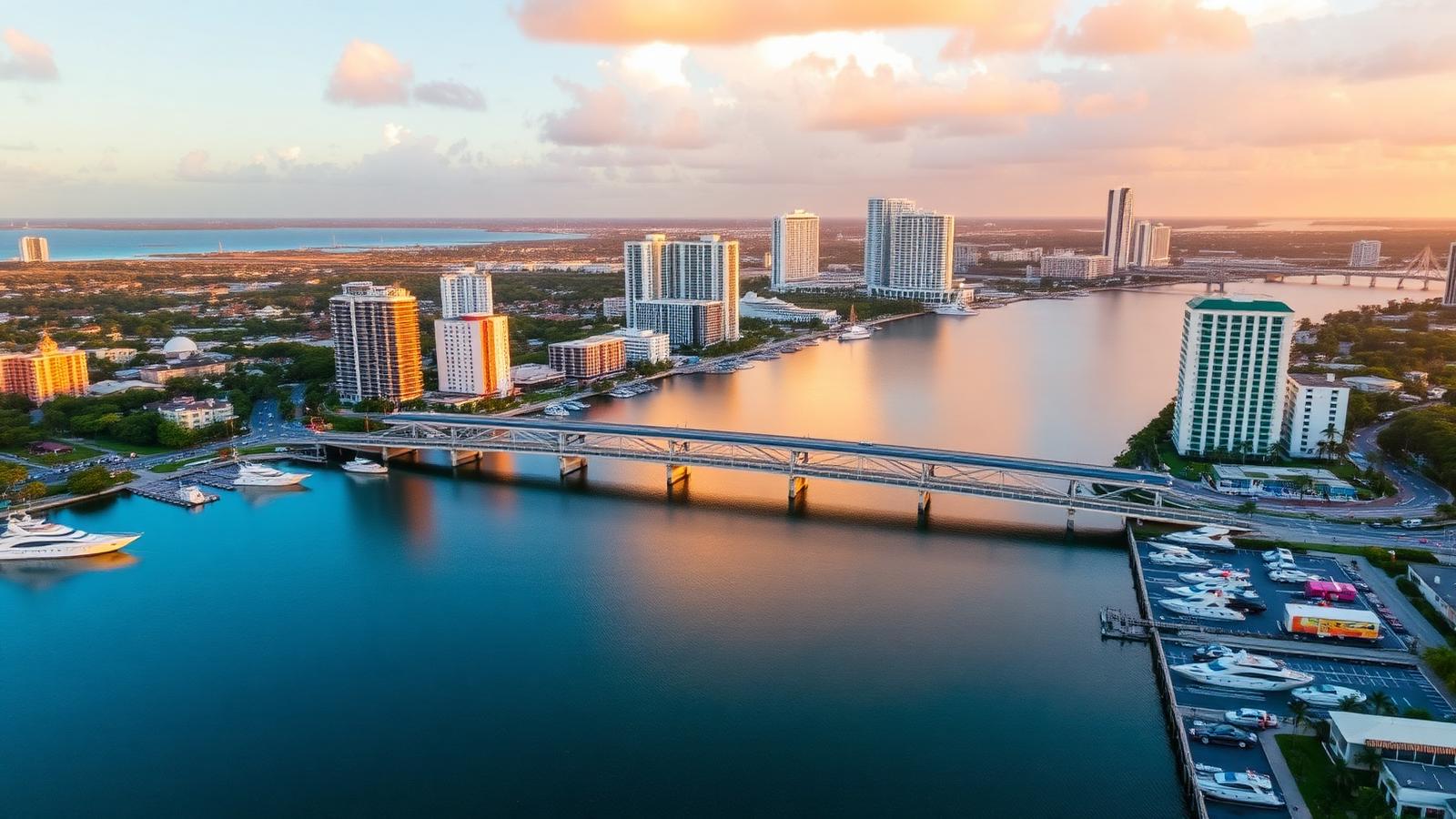
Roughly 185,000 people live in Fort Lauderdale proper, set inside a Broward County of about 1.9 million that sits flat between the Atlantic and the Everglades, threaded by more than 165 miles of navigable inland waterways. Water sits inside the neighborhoods here, not next to them — finger-canal streets where nearly every home has a seawall, a dock and often a lift, an Intracoastal spine running the length of the city, and the New River cutting through downtown. Port Everglades and the marine trades sit alongside tourism, healthcare and a growing professional workforce as the economic base.
That geography splits demand into three separate patterns that no single channel can cover together. Salt air eats through coils, fasteners, fencing, rebar, coatings and marine hardware far faster than it does fifteen miles inland, generating a steady replacement workload that belongs to organic search. Hurricane season runs June 1 through November 30, king tides push water up the canal streets on a predictable schedule, and stalled systems like April 2023's storm can dump over a foot of rain on the city in a single day — that spike volume is paid search's job, and it has to move within the hour. Separately, a large elective backlog sits on the area's high-value properties: epoxy garages, travertine decks, pavers, turf, fencing, screen enclosures, docks, full remodels — work nobody types a search query for, which puts it squarely on social.
One site has to serve all of it at once — a homeowner standing in ankle-deep water checking their phone and an owner signing off on a $60,000 seawall against a property worth several million. Split those four disciplines across four vendors and each one bills full Broward rate for its own slice while nothing covers what falls between them.
Step 3 — the build
The build order: one waterway map, one landing surface, one shared ledger.
It starts with a single map instead of four competing guesses. The Broward roster — Las Olas Isles, Rio Vista, Harbor Beach, Victoria Park, Coral Ridge, Imperial Point, Sailboat Bend, Wilton Manors, Oakland Park, Lauderdale-by-the-Sea, Pompano Beach, Plantation, Davie and Sunrise — gets locked in once and every channel builds against it: pages, bids and audiences all reference the same geography.
That map feeds a single landing surface. Whatever brought the visitor in — a ranked page, a paid click, a social ad — routes to a scope-specific page on one fast site with click-to-call fixed in the header, and every page carries LocalBusiness, Service and FAQ schema naming Fort Lauderdale explicitly, so traffic from every channel converts against the same infrastructure and AI answer engines have one consistent record to cite.
Underneath that sits one measurement rule: only a verified call or form from someone who wants work done locally counts as a qualified inbound, checked by neighborhood and by channel, rolling up to a single cost-per-inbound figure. Rankings, impressions and reach stay diagnostics — never the scoreboard itself.
On top of that ledger sits the trade only a single accountable team is positioned to make: as a flood event hits, emergency paid spend gets its caps raised while elective social goes quiet in the affected neighborhoods; during a dry February, the money flows back into elective social while paid search idles. A vendor who only owns one of those channels has no structural reason to ever recommend shifting money away from their own invoice.
Step 4 — the payoff
Bundled across Broward, four channels underprice four vendors bought separately.
The savings are mechanical, not aspirational. Improve site speed once and organic, paid and social traffic all convert better at the same time. Reviews and job photography gathered for search reuse as social creative and paid ad extensions at no added cost. Paid search data shows which Broward neighborhoods and job scopes actually convert, which then tells the content team what to build and the social team where to spend. A homeowner who has already seen your work three times in their feed is far more likely to click your listing when they finally search.
The other direction saves just as much. No more paying premium South Florida click prices for demand organic could hold on its own, no more buying resold leads that two competitors already bought that same afternoon, no more running an elective campaign into a neighborhood dealing with standing water. Because one team can see the whole ledger, a channel that stops earning its keep gets cut inside a month instead of defended out of habit for a year.
Step 5 — the trade-off
What no single channel can carry by itself on the canals.
Organic search here builds steadily but can't flex — left alone, it goes quiet exactly during the storm weeks that produce the year's sharpest demand. Paid search reacts within the hour and never accumulates value — left alone, it means renting every call forever at Broward's inflated prices. Social advertising sells high-margin elective work and disappears the moment an emergency hits. A fast site multiplies whatever traffic shows up and produces none on its own.
Each of those gaps sits exactly where a different channel is strongest, and that pattern isn't a coincidence to exploit later — it's the entire case for the framework. Four channels bought as separate contracts produce four partial coverages, each one defended for its own sake. Four channels installed as one system leave no seams for the county's calendar to slip through.
Where we run master framework in Fort Lauderdale
The Master Framework for service businesses across Fort Lauderdale and Broward County, plus the satellite towns crews already drive to. Every district below is targeted by name in campaigns, pages and profile service areas — not folded into a single city radius.
- Fort Lauderdale districts
- Las Olas Isles · Rio Vista · Harbor Beach · Seven Isles · Bay Colony · Victoria Park · Colee Hammock · Sailboat Bend · Coral Ridge · Imperial Point · Bermuda Riviera · Coral Ridge Country Club · Flagler Village · Edgewood · Melrose Park
- Beyond the county line
- Wilton Manors · Oakland Park · Lauderdale-by-the-Sea · Pompano Beach · Plantation · Davie · Sunrise · Lauderhill · Tamarac · Dania Beach · Hollywood · Weston · Coral Springs · Broward County
- ZIP codes covered
- 33301 · 33304 · 33305 · 33306 · 33308 · 33309 · 33311 · 33312 · 33313 · 33315 · 33316 · 33317 · 33319 · 33322 · 33324 · 33334 · 33351 · 33062 · 33064 · 33069

Step 6 — the Broward baseline
One canal county, one system, one number.
Fort Lauderdale combines expensive attention, large project tickets, salt-driven corrosion and a storm calendar that can rewrite priorities overnight. That combination punishes marketing that can't move fast and marketing that can't prove its own results — and both failures come from the same root cause: no one owning the entire picture.
Extentus runs the whole engagement as one Broward County operation: search wins the durable baseline neighborhood by neighborhood, paid search buys the specific hours that carry the month, social manufactures elective demand on the property the whole waterway can see, and the site converts every bit of it while handing Google and AI answer engines a single record to cite.
One strategy, one budget moving between four channels as the county's conditions shift, and one shared record of what actually produced work — installed together because splitting it up never adds up to the same result.
Master Framework in Fort Lauderdale — questions, answered
Not once you account for what gets missed. Broward County produces three separate demand patterns at once — a salt-driven replacement baseline, sharp storm-season emergency spikes, and a large elective backlog on high-value waterfront property — and a single channel only ever covers one of them. Starting with one means paying full South Florida rate for a slice of the market while the rest goes unanswered, with no one positioned to move budget the moment a flood week or a dry stretch changes what's worth buying.
One figure, broken down by channel and by neighborhood: qualified inbound, cost per qualified inbound, and the specific pages or campaigns behind it. A qualified inbound is a call or form checked against recordings from someone who wants work done in the area. Rankings, impressions, reach and engagement get logged as background diagnostics only, since none of them show what a booked job cost in Coral Ridge versus Plantation.
Yes, within hours rather than at a scheduled review. When a tropical system or a stalled rain event moves in, emergency paid search caps rise, spend concentrates on the affected neighborhoods, and elective social pauses there entirely — both because it stops converting and because a pool-deck ad next to a flooded street reads badly. Once the event clears, spend returns to the elective and baseline programs while organic search keeps compounding through the whole cycle, which is what keeps that flexibility affordable.
The four Fort Lauderdale pages, individually
Each discipline's own Fort Lauderdale page — its own local search data, its own market detail, its own URL.
- SEO
Search Engine Optimization in Fort Lauderdale
The channel you own. Google Business Profile, Broward County service-area pages and review velocity, built so Fort Lauderdale searches for your trade land on you instead of a Miami-based franchise bidding north up I-95.
Open page - Google Ads
Google Advertising in Fort Lauderdale
The channel you rent, deliberately. Paid search and Local Services Ads bid by Broward neighborhood and by hour so you are present for the storm week, the heat wave and the Sunday-night failure that SEO cannot flex around.
Open page - Social Ads
Social Advertising in Fort Lauderdale
The channel that creates demand. Meta and TikTok campaigns for elective, high-margin outdoor and finish work — aimed at canal and coastal neighborhoods at a fraction of what an emergency search click costs in Broward County.
Open page - Web Design
Web Design in Fort Lauderdale
The multiplier. Fast, credible, click-to-call sites built as conversion infrastructure — and structured with schema so AI answer engines can cite your Fort Lauderdale business by name.
Open page